
Leave-In Conditioner vs. Lotion: Why Thickness Matters for 3B Hair
Stop guessing with product labels and start matching viscosity to your curl density for lasting definition.

If you have been struggling with 3B curls that either look frizzy by noon or droopy and stringy by 2 PM, the culprit likely isn't your styling technique. It is physics. Specifically, it is a mismatch between the viscosity of your product and the structural reality of your hair. We spend too much time staring at branding—“moisturizing lock,” “curl cream”—and not enough time analyzing the thickness of the liquid in the bottle.
For 3B textures—those springy, corkscrew curls roughly the diameter of a Sharpie marker—finding the sweet spot between hydration and hold is a constant negotiation. The choice between a standard leave-in conditioner and a thicker hair lotion is not a matter of preference; it is a calculation of density and porosity. Get the weight wrong, and you are fighting gravity all day.
The Physics of Viscosity and Curl Structure
Viscosity determines how a product interacts with the hair shaft’s cuticle. A thin, watery leave-in conditioner penetrates quickly but evaporates just as fast, often failing to provide the necessary "slip" to clump 3B curls together. Conversely, a heavy lotion packs the cuticle layers too tightly, suffocating the natural spring of the coil.
Think of your curl as a spring. A lightweight leave-in acts like oil; it keeps the mechanism moving but doesn't necessarily help it hold its shape against environmental humidity. A lotion acts like a heavy grease; it stabilizes the spring but can prevent it from compressing and expanding naturally. For 3B hair, which relies on that specific expansion to create volume and shape, using a product that is too heavy is a death sentence for volume.
Many clients come to the chair complaining that their hair "doesn't hold a curl." In 2026, with the rise of high-porosity dyes and heat styling, I am seeing that this is rarely a lack of styling gel. It is usually a failure of the preparatory moisturizer to provide the right baseline density.
When a Watery Leave-In Betrays You
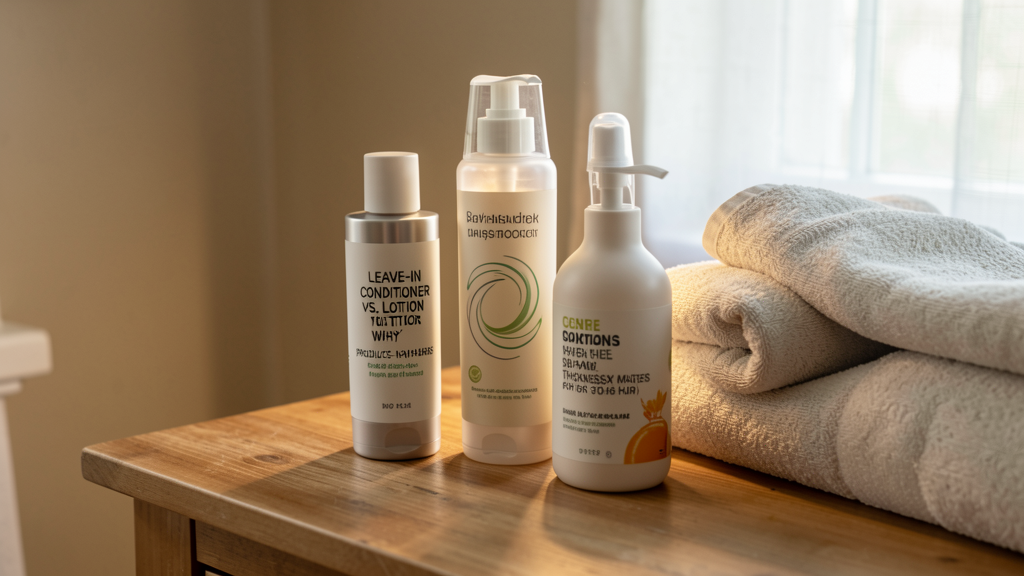
Let us address the watery leave-in conditioners first. These are typically formulated with high water content and lightweight humectants like glycerin or panthenol. For fine, low-density 3B hair, these can be excellent. However, if you have medium to high density or your hair is color-treated, a watery leave-in is a mirage. It provides an initial burst of hydration that feels great in the shower, but once the water evaporates, there is not enough lipid content left to seal the cuticle.
This leads to the "halo effect." Your roots might look decent, but the mid-lengths and ends frizz out because the moisture has escaped into the atmosphere. You might find yourself reaching for more product, only to end up with a sticky, undefined mess.
Furthermore, if you are still using shampoos that strip natural oils aggressively—a issue we covered in depth when discussing SLS vs. SLES: Why One Strips Oils and the Other Doesn't—your hair is starting at a deficit. Trying to fix that stripped-feeling hair with a watery conditioner is like trying to fill a bucket with a hole in the bottom. You need a product with enough body to stay put.
The Lotion Trap: Why Heavy Is Not Always Hydrating
On the opposite end of the spectrum is the hair lotion. These are rich, emulsified products often packed with butters like shea or cocoa. The mistake I see most frequently is 3B types using a heavy lotion designed for 4C coily hair. The logic is sound: "My hair is dry, so I need maximum moisture." The reality, however, is that 3B curls have a looser pattern. They do not require the same structural reinforcement that tighter coils need.
When you apply a thick lotion to 3B hair, you risk "weighing down the anchor." The roots are the first to suffer, losing their lift and lying flat against the scalp. Even worse, heavy lotions can create a barrier that prevents subsequent stylers—like gels or mousses—from bonding effectively. You end up with white flakes (product buildup) and curls that look like they are coated in wax.
The texture becomes dull rather than shiny. Because 3B curls reflect light based on their clumping pattern, a product that creates a heavy, opaque coating breaks up that light reflection. The hair looks matte and feels coated to the touch, rather than soft and hydrated.
The Decision Matrix: Density and Porosity
So how do you choose? You must ignore the label and look at the viscosity. I advise a simple test: dispense a pump of the product into your palm and tilt your hand 45 degrees.
If the product runs off your hand like water, it is a watery leave-in. If it stays pooled without moving, it is a cream or lotion.
Choose the Watery Leave-In if:
- You have low-density hair (your scalp is easily visible).
- Your hair is low porosity (products tend to sit on top rather than absorb).
- You live in a high-humidity climate and need to avoid swelling.
Choose the Lotion if:
- You have high-density hair (you have a lot of hair per square inch).
- Your hair is high porosity (it absorbs water quickly but loses it just as fast).
- You frequently use heat tools or have chemical damage.
For the majority of 3B clients I see, the "sweet spot" is actually a hybrid—a "cream-conditioner" that has the consistency of a loose lotion. It should offer enough resistance to stay on your hand but still flow slowly.
My Verdict: The Medium-Emulsion Approach
After fifteen years in the studio, my strong recommendation for 3B hair in 2026 is to abandon the ultra-lightweight leave-ins unless you are using them specifically for a spritz-and-go refresh. For your primary wash-and-go styling, you need a medium-emulsion lotion.
This type of product usually lists water as the first ingredient but includes cetyl alcohol or behentrimonium chloride high up in the list to provide that necessary anchor. These ingredients act as mild conditioning agents and detanglers without the heavy grease of shea butter. They allow the curl to clump (shingling) effectively without creating a cast that is too hard to break.
I am also a proponent of looking for water-soluble silicones in these lotions. In 2026, the fear of silicones has largely subsided among professionals, replaced by an understanding of their utility. Aloe dimethicone or PEG-modified silicones provide incredible slip that helps 3B curls snap into place, forming a uniform coil that dries with better definition. They seal the cuticle against humidity better than a purely oil-based lotion.
Execution: Applying the Right Thickness
Application technique must change based on your choice. If you are using a medium-thickness lotion, do not rake it through from root to tip with your fingers splayed wide. This breaks up the natural curl formation.
Instead, use the "praying hands" method. Smooth the lotion down the length of the hair shaft in sections. Then, cup the ends and gently scrunch upward to encourage the curl to spring back. Because you are using a product with more body than a water-based leave-in, you do not need to use as much of it. A nickel-sized amount per section is usually sufficient.
If you find that your ends are still feeling dry after applying your lotion, consider sealing them with a lightweight oil rather than adding more lotion. We have discussed how certain cheap oils mimic expensive serums perfectly for this purpose. A drop of jojoba or grapeseed oil over the lotion can lock that moisture in without adding the weight of a second layer of cream.
The Future of 3B Styling
The industry is moving away from the "cocktail" method of mixing five different products. We are seeing a rise in "smart" lotions that adjust their viscosity based on the friction of application, utilizing rheology modifiers. This is good news for 3B types who want definition without the guesswork.
Ultimately, you must stop trying to make your hair fit the product. If your curls are undefined, switch up the viscosity. If they are flat, dial it back. The health and appearance of your 3B curls depend on your willingness to listen to what the texture is telling you, rather than the marketing copy on the bottle. Match the weight to the density, and the pattern will follow.
Read next
SLS vs. SLES: Why One Strips Oils and the Other Doesn't
Understanding the molecular difference between Sodium Lauryl Sulfate and Sodium Laureth Sulfate is the key to stopping post-wash dryness without sacrificing foam.
Silicone Is Not the Enemy: Why Your Hair Needs Water-Soluble Options
Stop fearing silicones and start choosing the right ones to eliminate frizz without the heavy buildup.