
Silicone Is Not the Enemy: Why Your Hair Needs Water-Soluble Options
Stop fearing silicones and start choosing the right ones to eliminate frizz without the heavy buildup.


I had a client in the salon last week, a 3B curly girl named Sarah, who was on the verge of tears. She had spent the last six months strictly adhering to a "silicone-free" regimen she found on a forum. Her reasoning was sound in theory—she wanted breathable hair—but the result was a halo of frizz so dense I could barely see her natural curl pattern. She was convinced her hair was just "broken," but the reality was far simpler: she had removed the very ingredient that provided the slip and seal her texture desperately needed.
The war on silicones has been raging for years, but in 2026, we are finally seeing a shift toward nuance. The panic that led us to toss anything ending in "-cone" has caused more damage than it prevented for many hair types. The problem isn't the molecule itself; the problem is solubility. Distinguishing between buildup-causing non-soluble silicones and beneficial soluble ones is the single most important skill you can develop for your hair care routine. If you are avoiding all silicones and suffering from frizz and lack of slip, you are likely fighting a battle against your own hair biology.
The "Silicone Suffocates" Narrative is Flawed
The most pervasive myth in our industry is that all silicones create an impermeable plastic wrap around the hair shaft, suffocating it and blocking moisture. This is true for a specific category of silicones known as non-soluble or non-volatile silicones, such as Dimethicone or Cetearyl Methicone. These are heavy chains that cling to the hair cuticle. They are excellent at smoothing and sealing, but because they do not dissolve in water, they require harsh surfactants—often sulfates—to be removed. If you wash with a gentle, sulfate-free cleanser while using these heavy silicones, you will get buildup. That buildup creates a dull film, repels conditioner, and eventually leads to dryness.
However, this is not the whole story. To claim that all silicones behave this way ignores the chemistry behind water-soluble options. Ingredients like Dimethicone Copolyol, PEG-12 Dimethicone, or Lauryl Methicone Copolyol are formulated with water-loving side chains. They provide the same smoothing benefits and high shine as their heavier cousins, but when you rinse your hair, they wash away just like a water-soluble conditioner. They seal the cuticle to lock humidity out for the day but rinse clean that evening.
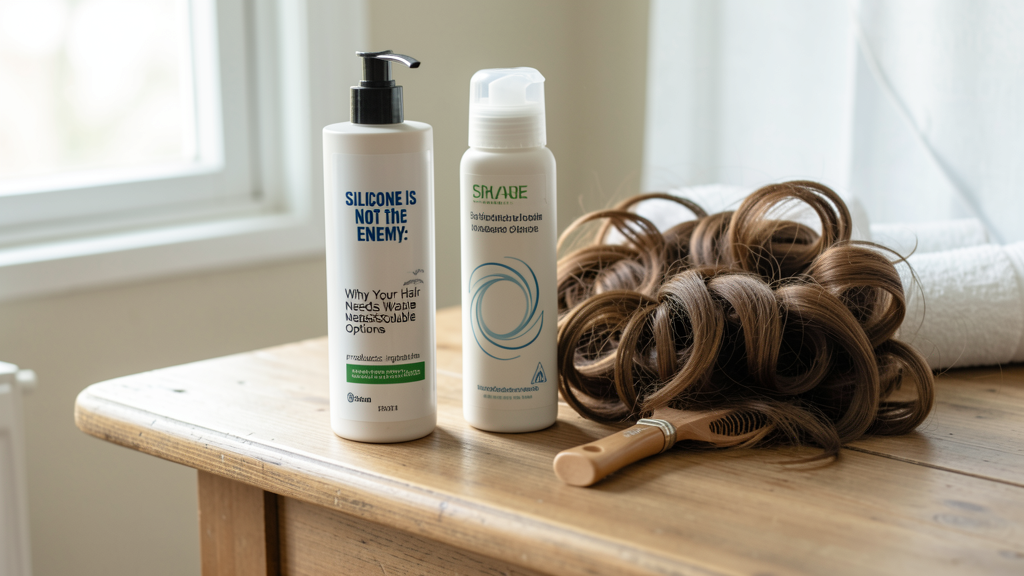
I see the suffocation myth most often damage clients with high-porosity hair. Porous hair has gaps and tears in the cuticle. A heavy, non-soluble silicone can indeed fill these gaps so effectively that it blocks subsequent moisturizing treatments. But a water-soluble silicone acts as a temporary bandage. It smooths the surface for styling, allowing the hair to retain length and elasticity, but rinses off before your next wash, letting your deep conditioner penetrate the shaft. You do not have to choose between protection and absorption if you are reading the label correctly.
You Don't Need Harsh Sulfates to Wash Them Out
The fear factor kicks in when people think about the removal process. We are conditioned to believe that "silicone use" equals "clarifying shampoo use." Clients tell me they avoid silicones because they do not want to strip their hair with SLS every week. This is a valid concern, but it stems from a misunderstanding of which silicones need that level of aggression.
There is a massive difference between stripping oils and removing product residue. If you are using water-soluble silicones, you do not need a harsh clarifying shampoo. You do not even need a sulfate. A mild cleansing conditioner or a shampoo with gentle surfactants can remove PEG-modified silicones effectively. The chemistry ensures that the bond between the silicone and the hair is broken by water exposure. SLS vs. SLES: Why One Strips Oils and the Other Doesn't explains this distinction well, but the short version is that you can keep your scalp's natural oils while still rinsing away water-soluble silicones.
The real issue arises when manufacturers mix heavy, non-soluble silicones into a product labeled "sulfate-friendly." I have reviewed countless "lightweight" serums this year that list Dimethicone as the second ingredient but market themselves as curl-friendly. This is where the betrayal happens. You use the serum, you wash with your gentle cleanser, and the film remains. Over four weeks, this cumulative buildup mimics dryness because your conditioner can no longer reach the cortex. The enemy is not the silicone category; it is the specific, non-soluble ingredient hidden in a bottle that claims to be easy on your hair.
Natural Oils Don't Always Offer Better Slip
There is a romanticized notion that plant oils are the "natural" alternative to silicones and should perform the same function. While I love a good argan or jojoba treatment, believing they can fully replace the functionality of silicones is a mistake that leads to mechanical damage. Silicones are synthetic polymers with a unique molecular structure that provides "slip"—that lubricated feeling that allows your fingers or a comb to glide through tangles without snagging.
Plant oils are lipids. They moisturize and add sheen, but they do not reduce friction as effectively as silicones. I see many clients trying to detangle thick, type 4 hair with just oil and water. The friction causes breakage and cuticle abrasion. A water-soluble silicone serum reduces that friction coefficient instantly, protecting the hair's integrity during the detangling process. 4 Cheap Oils That Mimic Expensive Serums offers great alternatives for hydration, but none of them can match the slip of a scientifically formulated polymer.
Furthermore, some heavy oils, like castor or coconut, can actually build up on the hair similarly to non-soluble silicones. They are not always water-soluble and can leave a sticky residue that attracts dirt. If you are swapping a lightweight, water-soluble silicone serum for a heavy butter, you might be trading one type of buildup for another, arguably stickier, one. The goal is to use the right tool for the job: oils for penetration and nourishment, water-soluble silicones for surface protection and slip.
Does Your Texture Actually Dictate Your Ingredients?
I often hear the advice that "fine hair should avoid silicones." This is a generalization that needs to die. Fine hair is the most susceptible to friction and tangling. A lightweight, water-soluble silicone can be a lifesaver for fine textures because it adds protection without the weight of a heavy oil or butter. The key is the evaporative nature of certain silicones. Cyclomethicone, for example, is a volatile silicone. It provides slip during application to help you distribute product evenly, and then it evaporates. It leaves no film behind, yet it made the styling process possible. It is arguably the best friend of fine, low-density hair.
Conversely, thick, coarse hair often loves the heavy hold of Dimethicone. That heavy layer can control volume and smooth massive frizz. If you have this hair type and you ban all silicones, you are fighting a losing battle against humidity. The trade-off is that you will need to use a stronger shampoo occasionally to remove it. That is a fair price to pay for the manageability it provides. To ban it entirely because "silicone is bad" is to ignore the specific mechanical benefits it offers your density. The judgment call should be based on your washing frequency. If you wash your hair twice a week, you can likely handle a non-soluble silicone. If you wash daily, stick strictly to water-soluble or volatile options.
The texture of the product also matters. Leave-In Conditioner vs. Lotion: Why Thickness Matters for 3B Hair highlights that viscosity dictates performance. A water-soluble silicone in a lotion base will offer different hold than a serum. We need to stop looking at the ingredient "silicone" as a monolith and start looking at the vehicle it arrives in.
The Conclusion Is Not a Summary
We need to reframe the conversation from "fear" to "utility." The industry has sold you the idea that a clean ingredient list is a binary state: silicone is bad, absent is good. But hair care is mechanical. It involves friction, cuticle alignment, and environmental exposure. Water-soluble silicones are a tool that addresses these mechanics with high efficiency and low risk of buildup when paired with the right cleansers.
I challenge you to stop scanning labels for the word "cone" and start scanning for the prefixes. Look for PEG, Hydrolyzed, or Dimethicone Copolyol. These are your safety words. They indicate that the product will give you the slip to detangle and the shine to face the day, but they will rinse away tonight. Do not let the fear of a heavy ingredient rob you of the benefits of a smart one. Your hair’s health depends on how you treat it, not just on what you avoid. If you are still struggling with frizz despite using expensive oils, the missing piece of the puzzle isn't more moisture—it's better surface management. Add a water-soluble silicone back into your routine and watch the mechanical breakage stop.
Read next
SLS vs. SLES: Why One Strips Oils and the Other Doesn't
Understanding the molecular difference between Sodium Lauryl Sulfate and Sodium Laureth Sulfate is the key to stopping post-wash dryness without sacrificing foam.

Leave-In Conditioner vs. Lotion: Why Thickness Matters for 3B Hair
Stop guessing with product labels and start matching viscosity to your curl density for lasting definition.