
The 100-Stroke Myth: Why Excessive Brushing Is Destroying Your Cuticle Integrity
Why the old advice of nightly 100-stroke sessions is mechanically damaging your hair’s cuticle layer and causing breakage instead of shine.


We have all seen the scene in period dramas or vintage cartoons: a woman seated at a vanity, counting rhythmically as she drags a brush through her hair until she reaches the magic number. One hundred strokes. It implies discipline, beauty, and a promise of mirror-like gloss. In 2026, with the advancements in trichology and hair fiber chemistry, we know better. Yet, I still see clients in my chair who admit to this nightly ritual, believing they are polishing their strands into submission. They are not polishing; they are sandpapering.
The logic behind the myth feels sound on the surface. Brushing distributes sebum from the scalp down the hair shaft, conditioning the ends. The friction, proponents argue, smooths the cuticle. The reality is far harsher. Hair is biological material, specifically keratin, and it has limits to its elasticity and structural integrity. When you attack it with excessive mechanical force, you are initiating a cycle of damage that no amount of serum can fix.
The Myth of Sebum Distribution: A Shortcut to Grease
Proponents of the 100-stroke method argue that without this manual labor, the natural oils from your scalp will never reach your thirsty ends. There is a grain of truth here—sebum is the best conditioner nature designed. However, the method of transport is where the logic collapses.
Your scalp produces oil continuously. For individuals with fine, straight hair, sebum travels down the shaft relatively easily due to the lack of curl pattern obstruction. For those with textured or curly hair, the journey is naturally slower. Forcefully dragging oil down the hair shaft with a brush does not hydrate the hair; it merely coats the top layers of the cuticle.
I had a client last month, a wonderful woman with fine, bleached blonde hair, who complained that her hair was "stringy and heavy" by noon. She was brushing it religiously every evening. By mechanically over-distributing sebum, she was turning her roots into a grease trap while leaving the mid-lengths and ends coated in a film that attracted dust and pollution. We cut the brushing down to detangling only, and her scalp balance normalized within two weeks. You cannot force hydration through friction; you only succeed in moving dirt around.
Mechanical Damage is Invisible Until It Isn't
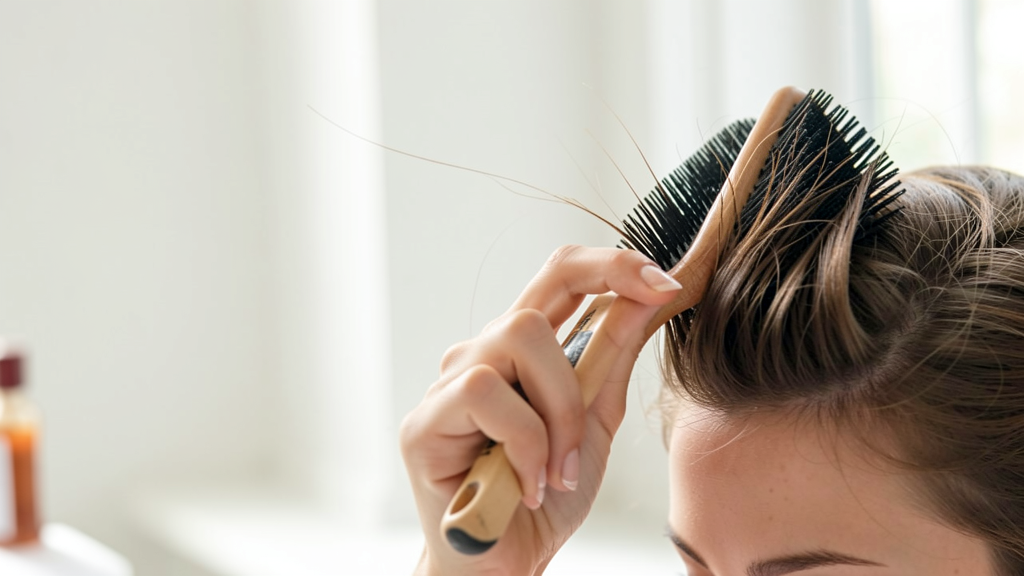
The core issue with the "100 strokes" rule is the physics of friction. Every time a bristle passes over a strand of hair, microscopic interactions occur. The cuticle, which looks like shingles on a roof under a microscope, is designed to lie flat. When you brush gently, these shingles align. When you brush excessively, the friction creates static electricity and localized heat.
This heat, combined with the abrasive action of the bristles, causes the cuticle edges to chip and lift. Once the cuticle is lifted, the inner cortex of the hair is exposed. The cortex is responsible for the hair's strength and pigment. Once compromised, the hair loses its structural cohesion. It becomes porous, soaking up humidity and frizzing instantly, or snapping under the slightest tension.
I often see this damage manifest as "trichoptilosis," or split ends, occurring inches away from the actual tips of the hair. These are the mechanical stress fractures from over-brushing. You are effectively creating split ends from the middle up. No amount of trimming will fix this permanently if the habit continues. You are spending money on step-by-step tutorials on how to lock bobby pins for your updos, but the hair is breaking because of the prep work, not the style itself.
Does Brushing Actually Stimulate Scalp Circulation?
Another common justification for the marathon brushing session is scalp health. The claim is that the stimulation invigorates blood flow, thereby boosting hair growth. While gentle massage does increase blood flow, aggressive brushing does not. It pulls on the root, causing traction alopecia and scalp inflammation.
Think about the mechanics. If you brush your hair 100 times, you are likely repeatedly passing over the same sections of hair at the root line. This creates tension. If you have ever wondered why does my ponytail give me a headache, consider the role of daily scalp tension. Repeated tugging on the follicle can cause them to loosen over time. Furthermore, if you are using a brush with sharp nylon balls or worn-out boar bristles, you are creating micro-abrasions on the scalp. A healthy scalp needs a balanced microbiome, not to be scrubbed raw like a kitchen floor.
If you want stimulation, use your fingertips or a scalp massager specifically designed for the task. Do not rely on a tool designed to detangle the lengths to perform a medical-grade massage on your skin.
Why the "100 Strokes" Rule Was Written for Different Hair
We must contextualize this advice. The "100 strokes" rule originated in an era before indoor plumbing, dry shampoo, and mild detergents. People washed their hair once a month, if that. They used heavy pomades and oils to style it, which would build up and attract vermin or simply smell rancid. Brushing was a hygiene necessity to remove debris and distribute the heavy oils that were coating the hair to prevent it from looking like straw.
In 2026, we have sophisticated cleansing agents, conditioners with cationic surfactants, and silicone-free oils that mimic sebum without the grease. We wash our hair frequently enough that natural distribution is not a crisis. Applying a Victorian hygiene standard to 21st-century hair care is ridiculous. We are not trying to repel lice or remove soot from coal fires. We are trying to preserve the cuticle.
The tools have changed too. Historical brushes were often soft boar bristle. Today, many people use plastic paddle brushes with rough seams. Running a seam-heavy plastic brush over fine hair 100 times is comparable to taking a piece of silk and rubbing it with sandpaper. The outcome is inevitable: pilling and breakage.
Friction: The Silent Killer of Cuticle Integrity
Let's get specific about the damage. When hair is wet, it swells and the cuticle lifts slightly. This is why we warn against brushing wet hair. But dry hair is not invincible. Dry friction causes a phenomenon called "trichorrehexis nodosa," where the hair node weakens and looks like the stalk of a bamboo plant. This is often the result of aggressive mechanical force.
Every time you stroke that brush, you are generating friction. Friction negates shine. Shine is created by light reflecting off a smooth, flat surface. If your cuticle is riddled with micro-fractures from over-brushing, the light scatters. The hair looks dull. So you brush it more to make it shiny. You are chasing a high that the brushing itself is destroying. It is a vicious cycle.
I advise clients to switch to a wide-tooth comb or a brush with widely spaced, flexible bristles for detangling. Detangle once to smooth, style once to set. That is it. If you are looking for volume, you are better off using heatless rods or foam rollers which create lift without the repetitive friction of a brush. The goal is manipulation, not annihilation.
Rethinking the Ritual
It is time to retire the 100-stroke myth. It belongs in the archive alongside lead face powder and mercury-laden hat treatments. Healthy hair in 2026 is defined by preservation, not aggressive grooming. The "shiny" hair you see on editorial models is usually the result of high-grade glossing sprays and precise cutting techniques that remove weight, not a woman locked in a bathroom counting to a hundred.
Focus on the products you use. A lightweight oil applied to the mid-lengths will give you the gloss that 100 strokes promises but fails to deliver. Protect your hair from the elements and treat it with the respect you would treat a cashmere sweater. You would not scrub a cashmere sweater with a stiff brush for five minutes a night to make it shine; you would destroy the fibers. Your hair is just as delicate.
We need to shift our mindset from "working on the hair" to "leaving the hair alone." The less you mess with it, the better it looks. Trims every six to eight weeks, proper moisture balance, and gentle detangling are the only secrets you need. Stop counting, start feeling. If your scalp feels tight or your brush feels rough, stop. Your hair will thank you by staying on your head rather than breaking off in your brush.
Read next

Why Does My Ponytail Give Me a Headache?
Understanding the specific nerve response triggered by tension at the temples can save you from migraines while keeping your style intact.

The Counter-Intuitive Twist: Locking Bobby Pins Against Gravity
A technical breakdown of the friction method and 180-degree rotation that keeps updos intact for over 12 hours.