
Denman Brush vs. Wide-Tooth Comb: Which Defines 4C Curls Better?
Achieving smooth, uniform clumps on 4C hair requires a specific mechanical approach, and the choice between dense bristles and wide teeth determines whether you get definition or volume.

The struggle to transform a cloud of frizz into a roped, hydrated spiral is the defining challenge for many with type 4C hair. I have analyzed thousands of curl patterns in the lab and through field observation, and the culprit often isn't the product regimen. It is the tool used to distribute that product. Specifically, the friction applied during the styling phase dictates whether strands move independently or unify.
For years, the wide-tooth comb has been touted as the holy grail for natural hair to prevent breakage. While it is unmatched for detangling, it fails spectacularly at the precise job of "definition" as most 4C wearers desire it: smooth, clumped spirals that dry with a glossy sheen rather than a matte texture. The mechanism required to align tightly coiled strands into a unit is fundamentally different from the mechanism required to separate them. To understand why the Denman brush often triumphs in this specific arena, we must look at the physics of surface tension and cuticle alignment.
The Physics of Curl Clumping vs. Separation
Curl definition is essentially the result of adjacent hair strands bonding together to form a "clump" or "cast." This bond is facilitated by the surface tension of water and the polymers in styling products. When strands are aligned parallel to one another, the water molecules between them create a cohesive force, pulling the strands tighter together as the water evaporates.
A wide-tooth comb operates on a principle of separation. Its wide prongs are designed to glide through the hair, creating channels and pushing strands away from each other. For looser curl patterns (2A to 3C), this separation allows natural groupings to form without interference. However, 4C hair lacks the inherent weight and circumference to fall back into these groups on its own. Once a comb tooth passes through a section of 4C hair, the strands often remain where they were left—separated, fuzzy, and prone to tangling with neighboring disparate groups.
Conversely, the dense row of bristles on a Denman brush acts as a smoothing plate. As the brush passes through a section, it forces the strands to lay parallel to one another over a continuous surface area rather than intermittent points of contact. This mechanical alignment does the work that gravity does for looser textures. It organizes the chaotic coil structure into a unified stream, allowing the styling product to bind the strands together effectively. How I Styled Two Textures for 18 Months Without Cutting My Hair taught me that mixed textures often require this mechanical intervention to find harmony, a principle that applies strictly to dense 4C coils seeking uniformity.
The Limitations of Raking for Definition
The "raking" method, typically performed with fingers or a wide-tooth comb, is a staple in the natural hair community. It is gentle and efficient for application. Yet, for the 4C client complaining of "undefined frizz," raking is often the primary antagonist.
When you rake through 4C hair with a comb, you are essentially combing out the definition that the shrinkage is trying to create. You are disrupting the natural wave pattern that exists at the microscopic level. Furthermore, the application of friction via a comb can lift the cuticle scales slightly, especially if the hair is slightly dehydrated. Lifted cuticles scatter light, creating a dull appearance, and catch on one another, creating friction-induced frizz.
I have observed that combs tend to push product away from the roots and toward the ends, leaving the critical mid-shaft and root area under-saturated. This uneven distribution leads to a situation where the ends are weighed down and the roots are puffy. This lack of uniformity prevents the formation of a consistent curl pattern from root to tip. While 5 Protective Styles That Don't Tangle Fine Edges rely on this tension-free movement to protect the hairline, a wash-and-go relies on controlled tension to define the pattern.
How Dense Bristles Reorganize the Cuticle Layer
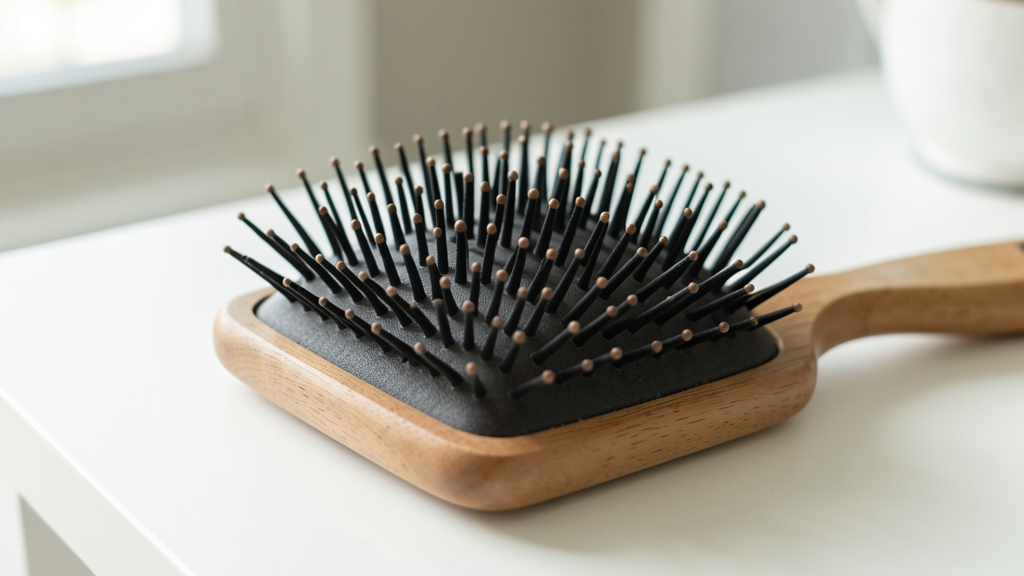
The Denman brush, particularly the classic D3 or D4 models, offers a distinct advantage through its rubber pad and nylon bristles. The rubber pad provides a cushion that bends with the scalp's contour, while the bristles offer just enough resistance to grip the hair without pulling it from the root.
Crucially, the action of brushing can smooth the cuticle layer. Scientific research in cosmetic chemistry suggests that mechanical smoothing in the presence of lubricants (conditioners or leave-ins) helps to align the cuticle scales in a "tiles-on-a-roof" orientation. This alignment is critical for 4C definition because it reduces inter-fiber friction. When the cuticles are smooth, the strands can slide past one another to tighten into a curl, rather than snagging and creating a halo of frizz.
The density of the bristles ensures that styling products are not just distributed, but are pressed into the hair shaft. This increases the absorption of humectants and emollients, which is vital for low porosity hair types often found within the 4C spectrum. Do You Really Need to Wash Low Porosity Hair Less Often? is a common question, but the real issue is often penetration. The brushing action forces product deeper into the cortex than a comb ever could, ensuring that the hair retains the moisture necessary to hold the curl clump as it dries.
Decision Criteria for the 4C Curl Pattern
If your objective is the elongated, rope-like spiral often seen on "curly girl" Instagram feeds, the criteria overwhelmingly favor the brush, provided you accept the trade-offs.
1. Density and Strand Thickness
If you have high-density 4C hair, a comb will get lost in the volume. It cannot effectively manipulate the interior strands of a thick section. A Denman brush can handle a larger volume of hair per pass, exerting influence on a greater number of strands simultaneously. For finer, low-density 4C hair, a full-row Denman might be too aggressive; in this specific case, removing rows from the brush is a necessary modification to prevent snapping the delicate strands.
2. The Wet Factor
The Denman is strictly a wet-hair tool for 4C types. Using it on dry hair is a recipe for mechanical breakage. If you style on dry, stretched hair, a wide-tooth comb or pick is the safer, more appropriate choice. But for defining a fresh wash, the brush wins because water acts as the plasticizer that allows the hair to be remolded without fracturing.
3. The Desired Outcome: Clump vs. Volume
This is the final deciding factor. If you want "hair that moves" with maximum volume and airy separation, the comb is superior. It preserves the texture's natural "bloom." However, if you are fighting the "struggle stage" where your hair looks like a tangled cloud rather than a curated style, you want clumps. You want the strands to stick together. Only the brush provides the surface area and smoothing action required to achieve that level of cohesion.
When Mechanical Outweighs Minimalist Styling
There is a valid concern regarding over-manipulation. 4C hair is the most fragile curl type due to the sharp angle at which the follicle exits the scalp, creating points of high stress. Adding a brush into the routine adds another step of manipulation. However, the trade-off is a reduction in daily detangling time.
When a Denman brush is used to create smooth, well-defined clumps, the hair sets in a uniform pattern. This uniformity prevents the strands from interlocking with neighbors in a chaotic way. I have found that clients who brush for definition report significantly less single-strand knots and fairy knots in the weeks following their wash day. The initial mechanical stress of brushing pays dividends in the reduction of mechanical stress during the week, as the defined clumps tangle less than combed, fluffy hair.
My verdict is decisive. For the specific problem of inability to create smooth, clumped curl patterns on coily hair, the wide-tooth comb is the wrong tool for the finishing step. It is an excellent prep tool, but a poor finishing tool. The Denman brush, used on soaking wet hair laden with slip, is the superior instrument for defining 4C hair. It exploits the principles of friction and surface tension to create a structure that 4C hair struggles to maintain on its own.
Ultimately, definition is an act of organization. The wide-tooth comb creates chaos by spacing things out; the Denman brush creates order by bringing things together. For the 4C hair type seeking that highly sought-after spiral definition, order is exactly what is required.
Read next

Managing the Line of Demarcation: 18 Months of Transitioning Without Cutting
A detailed breakdown of blending relaxed roots with natural ends without the big chop, focusing on structural integrity and styling mechanics.

5 Protective Styles That Don't Tangle Fine Edges
Five specific updo techniques designed to redistribute mechanical stress away from the temporal hairline, preventing traction alopecia while maintaining length retention.