
The Mirror Hack That Finally Taught Me to French Braid
Fixing the hand-eye disconnect by mastering a specific mirror positioning that turns a backward motion into a forward visual guide.

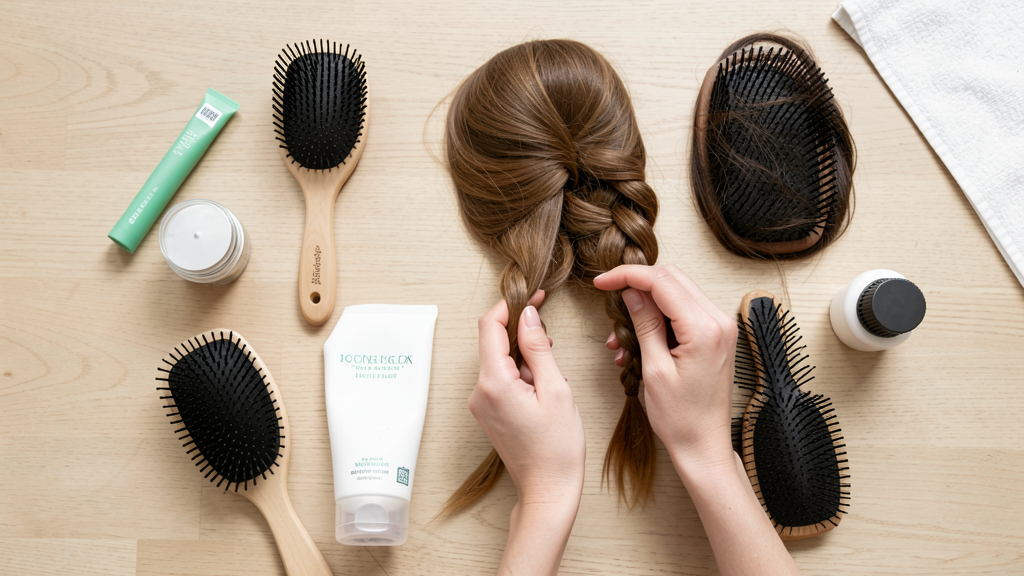
I have executed complex, stacked fishtail updos on brides in moving vehicles without breaking a sweat. I can replicate intricate folklore patterns on a mannequin blindfolded. Yet, for the first decade of my career, I could not French braid my own hair to save my life.
It was a persistent, humiliating blind spot. The coordination simply evaporated the moment I tried to work on my own head. My fingers, usually so precise, would fumble the cross-over. The sections would merge into a tangled mess. My neck would cramp, and eventually, I would throw a hair tie at the mirror and resign myself to a bun.
The breakthrough didn't come from practicing more. It came from a physics lesson on a rainy Tuesday afternoon in November 2025. I was prepping a client named Elena, a neurosurgeon, who complained that despite her elite hand-eye coordination, she couldn't manage a simple braid on herself. Watching her struggle, I realized the issue wasn't dexterity—it was geometry. We were both fighting the mirror's reversal.
Why Standard Reflection Fails the Brain
The fundamental problem with learning to French braid your own hair via a standard bathroom mirror is the inversion of the X-axis. When you braid someone else, you look down at the head. Your hands move forward, away from you, adding hair from the sides. The visual input matches the physical output.
When you turn around to braid your own hair, you are working blind. To see, you must face a mirror. Now, your hands are moving toward the reflection, but the reflection shows them moving toward you. Your brain, trying to process the "over-under" motion, receives delayed, flipped data. You reach for the left section with your right hand, but the mirror shows the hand coming from the right. That microsecond of cognitive lag causes the tension to slip.
For months, I tried to brute-force this disconnect. I would tilt my head back at an uncomfortable angle, trying to watch the back of my head directly in the reflection. It never worked. The sections were never clean, and the braid always sat too low.
The Geometry of the 45-Degree Offset
The solution arrived by accident. I was in the studio testing lighting setups for a shoot. I had positioned a large freestanding cheval mirror not directly in front of me, but off to the side, perpendicular to a wall mirror. I sat down to check my hair and realized that by looking into the wall mirror, I could see the reflection of the back of my head in the cheval mirror.
But I wasn't looking straight on. I was positioned at a 45-degree angle to the side mirror.
This angle changes everything. Instead of facing your hands head-on, creating that parallax error, you position your body sideways to the reflection. You look over your shoulder into the mirror, but you align your stance so that the "camera angle" of the reflection matches the direction of your hands.
Here is the precise setup I used to finally crack the code.
You need a freestanding mirror or a wall-mounted mirror you can stand next to, rather than directly in front of. Stand with your right shoulder facing the mirror glass. Twist your torso to the left, looking over your left shoulder to view the reflection of the back of your head.
In this position, when your right hand moves to cross a strand over, it moves away from your body in real life. In the reflection, because of the 45-degree offset, it also appears to move across the head laterally. The visual map finally aligns with the tactile sensation.
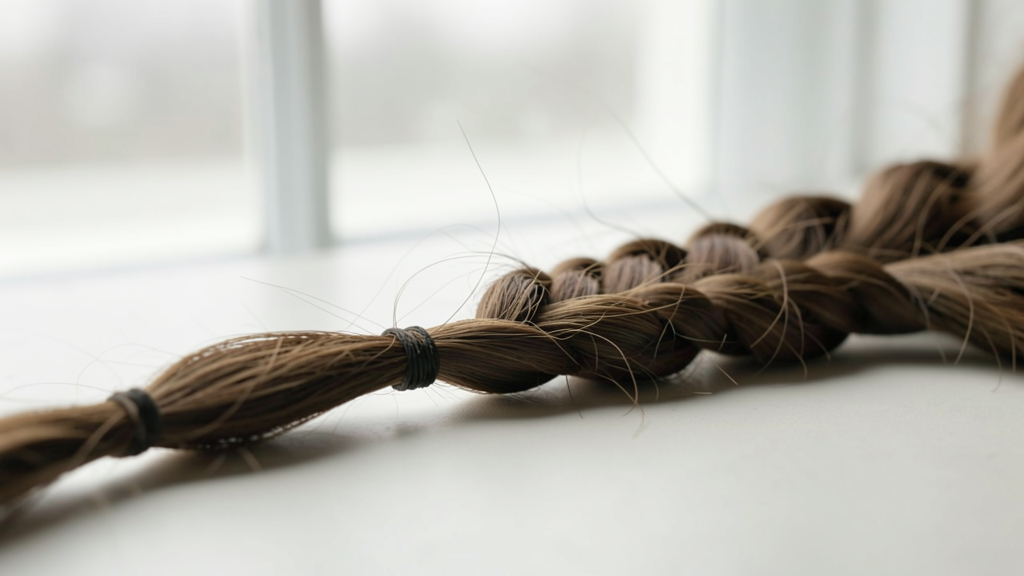
Executing the Braid with Visual Confirmation
Start with dry, textured hair. I have found that freshly washed, silky hair creates too much slippage when you are learning a new hand position. I often use heatless rods the night before to create the necessary grip.
- The Stance: Stand with your left shoulder pointing toward the mirror. You will be braiding the left side first. Look over your right shoulder into the mirror.
- The Sectioning: In the reflection, part your hair down the middle. Take a triangular section at the top of the left side. Divide it into three strands.
- The First Cross: Cross the right strand over the middle. Then cross the left strand over the middle. This is just a normal braid start.
- The Incorporation: Here is where the mirror angle pays off. Sweep a section of hair from the left hairline and add it to the left strand. In the 45-degree reflection, you will see your hand sweeping "up" the head in a way that feels natural. Cross that combined strand over the middle.
- The Pivot: Now grab hair from the right side (the part closest to the mirror) and add it to the right strand.
Because you are standing sideways, your wrist isn't contorted. The mirror is not showing you a reverse image of your hands crossing each other; it is showing you a profile view of the braid construction. You can see exactly how much hair you are picking up. You can see if the tension is uneven.
I completed my first self-French braid in under four minutes using this method. It wasn't perfect—the tension was a bit tight at the nape—but it was a French braid. It was intact. It didn't look like a bird's nest.
The Real-World Trade-Off
There is a caveat to this technique, and as a stylist, I must be transparent about it. It is not comfortable for your neck.
Maintaining the 45-degree stance requires you to keep your head turned for the duration of the styling. If you have cervical issues or limited neck mobility, this position will strain you. Furthermore, because you are relying heavily on visual confirmation rather than muscle memory, your speed will decrease initially.
You also need space. Unlike facing a bathroom mirror where you are stationary, this method requires a few feet of clearance to angle your body correctly. You cannot do this easily in a cramped airplane lavatory or a car visor mirror.
However, the precision you gain is worth the physical discomfort during the learning phase. Once your fingers memorize the "feel" of the sections matching the "look" in the mirror, you can slowly straighten your posture.
Another realization I had during this process involves the finish. I used to worry that my scalp was showing too much at the top. I tried to overcompensate by pulling hair too wide, which creates that tight, headache-inducing tension many people complain about. The mirror hack solved this. By seeing the exact geometry, I learned to keep the sections compact. A smaller, tighter initial triangle results in a braid that stays put without needing to be pulled rock-hard.
Refining the Technique
After mastering the position, I refined the actual fingerwork. I stopped using my fingertips to hold the sections and started using the "shelf" created by my palms.
When you look in the mirror at a 45-degree angle, your peripheral vision is limited. If you are holding strands with just your thumb and forefinger, they tend to slip. By opening the hand and letting the strands rest against the middle, ring, and pinky fingers, you create a stable platform.
I also learned to ignore the bottom half of the braid. Once the braid passes your ear, the reflection becomes difficult to manage without breaking your stance entirely. At this point, I switch to tactile feel only. I can feel the pattern emerging. The critical section is the top third—the crown area where the direction is set. That is where the mirror is essential. If the start is clean, the rest follows by inertia.
To finish, I secure the end with a clear elastic. If I want an updo, I wrap the braid into a bun and pin it. I use the technique of locking bobby pins to ensure the style doesn't slump, as the weight of a self-braid can pull differently than one done by a second person.
Why This Changes the Game
This method shifts the learning paradigm from "feeling your way in the dark" to "architecting the structure visually." It demystifies the French braid.
We often tell clients that braiding is just practice. That is only half true. Practice without accurate feedback loops reinforces bad habits. For years, my feedback loop was broken by mirror reversal. By correcting the angle, I corrected the input.
I taught this to Elena, the surgeon, the following week. She stood sideways to my studio mirror, positioned her body, and hesitated. Then, she picked up the first section. She moved slowly, watching the reflection. Her hands, which had been flailing a week prior, moved with surgical precision. She finished a braid that was整洁 (neat), symmetrical, and secure.
She laughed, turning her head to examine it in the front mirror. "I didn't know it was actually that simple," she said. It isn't simple. It is complex manual labor. But the mirror hack removes the artificial complexity of the visual dissonance. It leaves you with just the work.
The ultimate lesson here isn't just about hair. It is about identifying when your tools—or your environment—are working against your natural mechanics. Once you align the two, the skill follows.
Read next
The 100-Stroke Myth: Why Excessive Brushing Is Destroying Your Cuticle Integrity
Why the old advice of nightly 100-stroke sessions is mechanically damaging your hair’s cuticle layer and causing breakage instead of shine.
The Counter-Intuitive Twist: Locking Bobby Pins Against Gravity
A technical breakdown of the friction method and 180-degree rotation that keeps updos intact for over 12 hours.